One thing decides whether an Arabic file goes through smoothly, and it is not the translation itself. It is how your name is written. A name in Arabic script can be spelt three or four ways in English, and every one of them is correct.
You already picked one when your passport or BRP was issued. We use that spelling and nothing else, right through your Arabic birth certificate translation, so the two documents never disagree in front of a caseworker.
Your name spelt exactly as your passport shows it
Father's and grandfather's names laid out clearly
Handwritten and older records read by a person
Every seal and reverse-side entry translated
Certificates from Iraq, Egypt, Sudan, Syria and the Gulf
Back with you in 24 to 48 hours
A UK caseworker checks a short list on any translated certificate. The wording, the date, a real signature, the translator's professional membership, and a UK address and phone number they can use. All of that goes on every page we issue.
With Arabic there is a second layer. Arabic naming carries the father's name, and often the grandfather's, as part of a full name, while a British form expects a first name and a surname in separate boxes.
Put those together carelessly and a caseworker sees a name that does not match the passport in front of them. We lay it out so the connection is obvious rather than something you have to explain in a covering letter.
Tell us the spelling printed on your passport before a single word is written, and the rest follows easily.
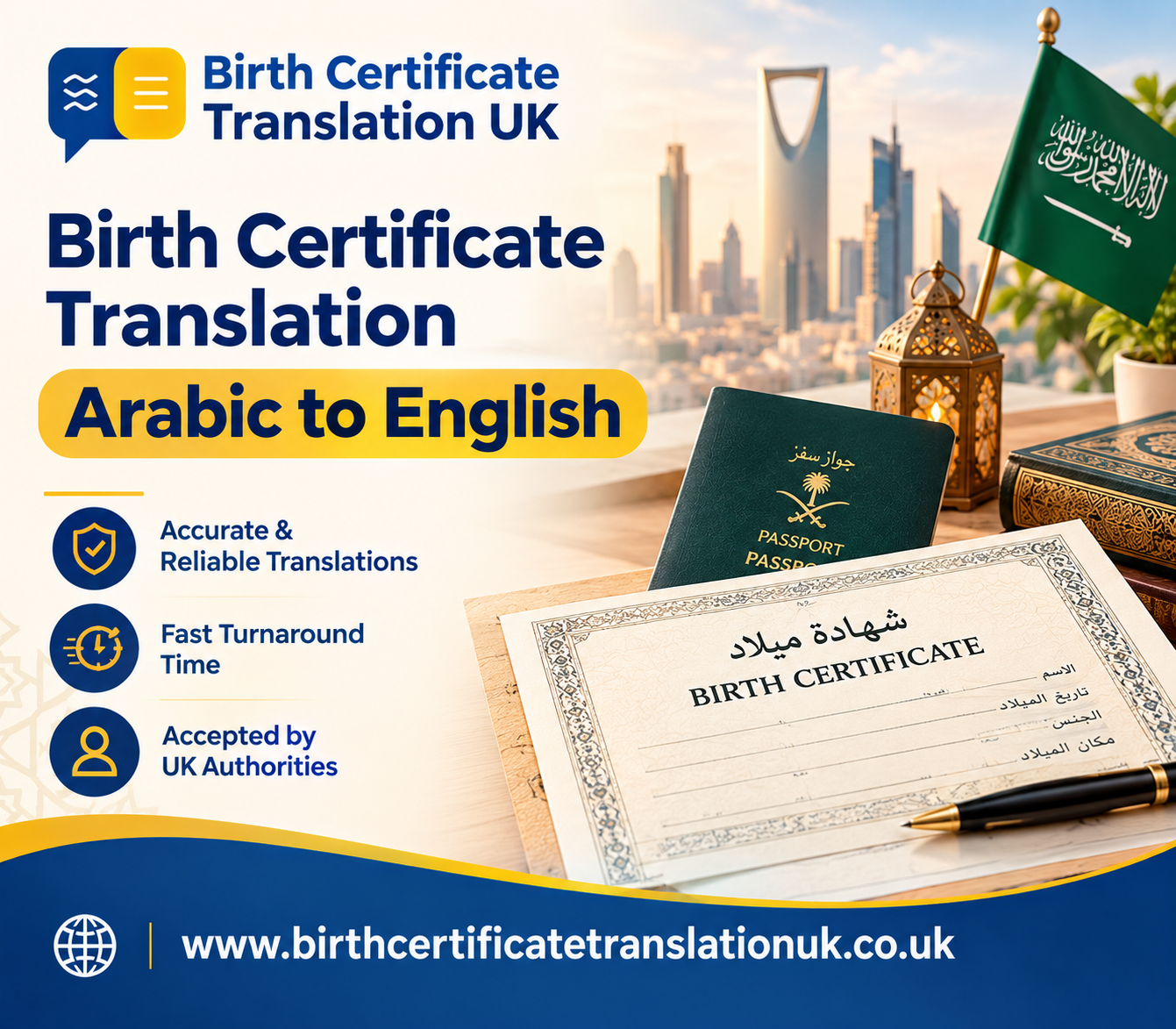
An Arabic certificate is read by different offices for different reasons, and what each one is checking changes what matters on the page. Below we explain where these documents usually go and what the reader is looking for.
The biggest share of our Arabic work. The Home Office already holds a version of your name from earlier applications, and a translation that spells it differently stops the file while someone checks whether two records are the same person.
Arabic certificates record parentage through a chain of given names rather than a surname column, which is not how a British form is built. The English page separates it out so an officer can see the child and the parents at once.
Visitor, student, spouse and work routes all ask for identity documents. Deadlines here are unforgiving, because a biometric appointment cannot be moved. Give us that date up front and we plan the job around it.
These files turn entirely on how people are related. Where a child's certificate names a father and grandfather, that chain has to read clearly in English so an officer can follow it.
Nothing moves at a register office until the paperwork can be read, and the waiting period starts only once the registrar accepts it. Where either partner was married before, those papers are translated in the same set.
Admissions teams, HR departments and DBS applications all need identity papers they can verify. Our UK address and telephone number sit on the page so they can.
Three steps, and the first takes a minute on your phone. Your original certificate stays with you, which matters because a UK office may ask to see it beside the English page.
Arabic certificates translated into English for UK offices.
Families from Iraq, Egypt, Sudan, Syria and the Gulf.
ATC accredited, and our credentials print on your page.
One fixed price, agreed first, with nothing added later.
Arabic certificates carry things a British one simply does not, and an office here needs those carried across rather than smoothed away. Below we go through each of them so you know what your page will show. The same care goes into every job our birth certificate translators in the UK take on.
This is the single thing that decides whether an Arabic file moves or stalls. Send us the spelling printed on your passport or BRP and we use it everywhere, so nothing in your bundle contradicts anything else.
Arabic full names carry generations inside them. We set them out so a British officer can see which part is the given name, which is the father's, and which is the family name.
Certificates from the 1960s and 1970s are often written by hand in a registry ledger. A person reads those rather than software, including notes squeezed into the margin.
Arabic certificates carry embossed seals and entries on the back that people forget to photograph. Everything on the paper appears in English, because a line missing looks like a missing page.
Iraq, Egypt, Sudan, Syria, Jordan, Lebanon, Morocco and the Gulf states all issue certificates that look different. We work with all of them rather than treating the region as one format.
Where a certificate carries a Hijri date, we give the Gregorian equivalent and print the original alongside it, so nobody has to work out which calendar they are reading.
The one printed on your passport or BRP. Tell us and we use it throughout, without exception.
This is the single biggest cause of delay on Arabic files. A name in Arabic script genuinely has three or four correct English spellings, and a translator choosing freely will pick one that may not be yours.
A caseworker holding your translation beside your passport has no way of knowing that two spellings mean one person. One line from you at the start removes the problem entirely.
Laid out so a British officer can follow them, with each part identified rather than run together.
Arabic full names carry the father's name, and frequently the grandfather's, as part of the name itself. A UK form expects a given name and a surname in separate boxes, and the two systems do not map neatly.
We keep every element from your certificate and show which is which. If your family uses a particular form on official papers, send it and we will follow that.
Yes. Certificates from the 1960s and 1970s were often entered by hand in a registry ledger, sometimes with corrections added years later.
A person reads those, including the marginal notes. Software fails on this kind of document, and the result reads as obviously wrong to anyone checking.
Photograph it in daylight with all four corners in frame. If one word is genuinely unreadable, we send you that section and ask rather than guessing.
No. Iraq, Egypt, Sudan, Syria, Jordan, Lebanon, Palestine, Morocco, Algeria, Libya and the Gulf states all pass through here.
Each issues certificates that look different, with their own registry wording, seals and layout. We do not treat the region as a single format.
Say which country issued the certificate when you place the order, and we will set the English page out to match what a UK caseworker expects.
Yes, and it is included. Everything on the paper has to appear in English, not only the details in the boxes.
People regularly photograph only the front. A line visible on your original with nothing matching it in the English version looks like a missing page to whoever is checking.
We give the Gregorian equivalent and print the original alongside it.
A British caseworker reading a date from a different calendar cannot tell whether it has been converted or simply copied. Showing both removes that question.
If your passport shows a different date from your certificate, tell us. That mismatch is worth flagging before the file goes in rather than after.
Yes, and doing it in one order matters more than the saving.
One translator across the set writes every name the same way on each page. With Arabic names in particular, splitting the work between two companies is how a bundle ends up contradicting itself.
Yes. Send us what they wrote along with the original certificate and the correction costs nothing.
On Arabic files it is almost always the name. The version on the translation did not match the BRP, and the caseworker could not confirm it referred to the same person.
We read the actual objection, ask you for the spelling on your card, and reissue. Corrected pages are usually back inside twenty-four hours.
© 2026 BirthCertificateTranslationUK.Co.UK. All Rights Reserved.